
Preparing Your Organization for AI
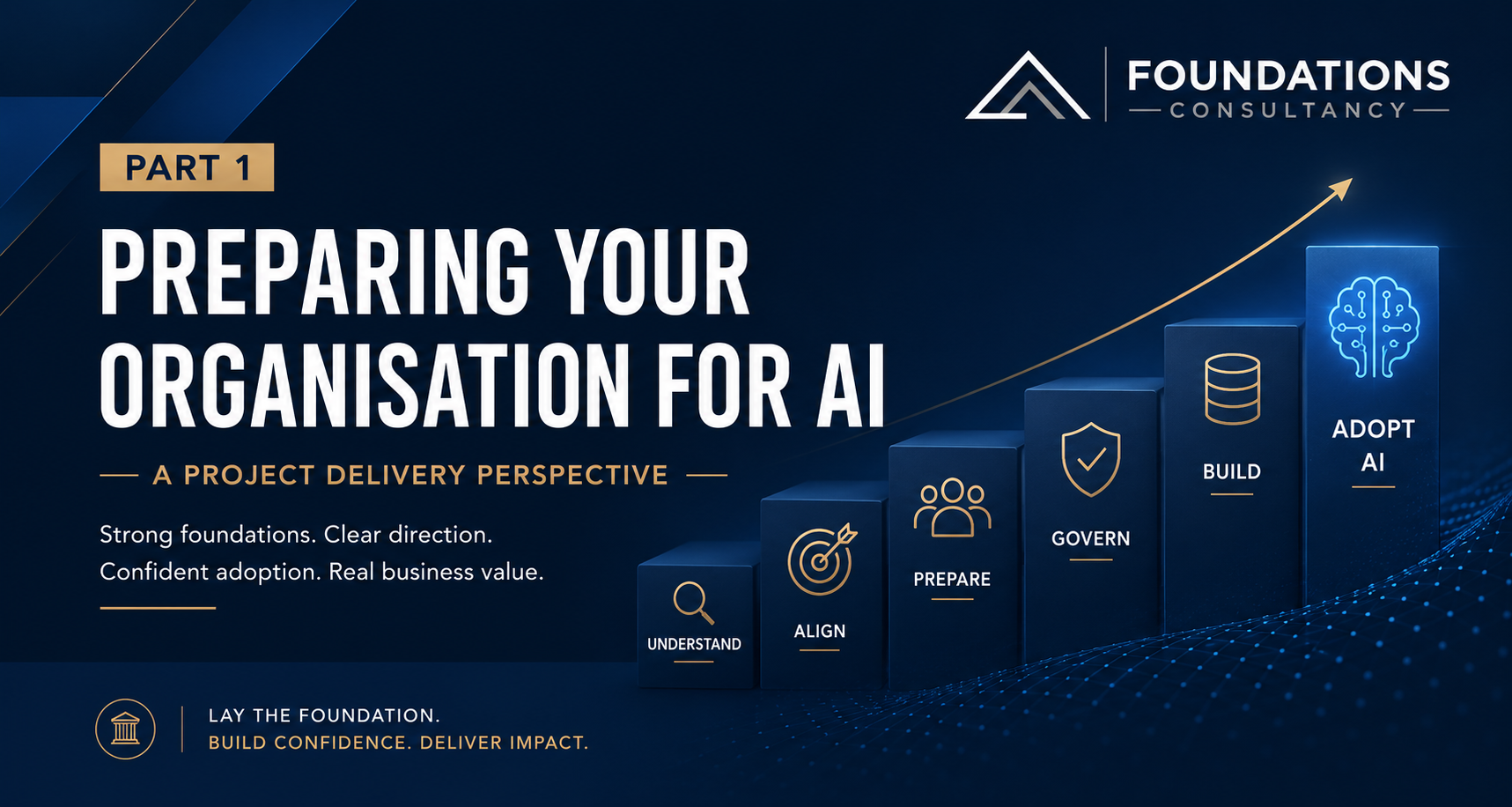
A Project Delivery Perspective
Artificial Intelligence isn't the future of business - it's already here. The question isn't whether organizations should start thinking about AI. The question is whether they're preparing for it in the right way.
Introduction
There isn't a day that goes by without another headline about Artificial Intelligence.
One article claims AI will replace millions of jobs, another predicts it will revolutionize every industry. Software vendors promise AI-powered solutions for almost every business problem, while social media is flooded with demonstrations of what the latest tools can achieve.
With so much noise, it's understandable why many organizations feel pressure to "do something with AI."
But that's also where many businesses make their first mistake. They begin by looking for an AI solution before they've properly understood the problem they're trying to solve.
Having spent years delivering technology programs, governance frameworks and business transformation initiatives, I've noticed something interesting. The organizations that adopt new technology successfully rarely start with the technology itself; They start with people, with processes, and they clearly understanding the business challenge.
AI is no different.
Despite all the excitement surrounding it, AI should still be treated like any other business capability. It needs clear objectives, good governance, it needs engaged stakeholders and it needs quality data. And most importantly, it needs people who understand how to use it responsibly.
This article isn't about choosing the right AI platform or comparing language models, it's about laying the foundations that allow AI initiatives to succeed.
Because before AI transforms your organization... Your organization needs to be ready for AI.
Separating the Hype from Reality
AI Won't Fix Broken Processes
One of the biggest misconceptions surrounding AI is that it somehow fixes inefficient ways of working - It doesn't. In fact, AI often exposes weaknesses that organizations have been living with for years.
Imagine a team manually processing customer requests. Perhaps the approvals are inconsistent, different people follow different processes, documentation isn't always complete and information is stored in multiple locations. Introducing AI into that environment won't magically create consistency, instead, it may simply process inconsistent information much faster.
Bad processes don't become good processes because AI is involved, they become faster bad processes - That's an important distinction.
Before introducing AI into any workflow, ask yourself:
Is this process clearly defined?
Is it consistently followed?
Are roles and responsibilities understood?
Would I be comfortable automating this today?
If the answer is no, fixing the process should come before introducing AI. Technology should amplify good processes, not compensate for poor ones.
Start With Business Problems, Not AI
One question appears in almost every leadership meeting today:
"How can we use AI?"
It's understandable, AI is exciting, and organizations don't want to be left behind. But it's the wrong question.
Instead, ask:
What's frustrating our people today?
Perhaps reporting takes too long, maybe customer enquiries require repetitive responses, or project managers spend hours preparing weekly updates. Maybe knowledge is scattered across dozens of documents.
Those are business problems.
AI simply becomes one possible solution and the best AI projects rarely begin with technology, they begin with someone saying "There has to be a better way to do this."
If AI helps solve that problem, excellent, but if another solution works better, that's equally valuable. Technology should always serve the business, not the other way around.
AI Isn't an IT Project
This is probably the most important lesson in this article - AI is not an IT initiative.
Yes, technology teams play an important role, they'll evaluate platforms, manage integrations, support infrastructure, and protect data, but successful AI adoption reaches far beyond technology. Business leaders define priorities, legal teams consider regulatory implications, information security protects organizational data, HR helps employees adapt, change managers build confidence, governance teams establish clear boundaries, project managers coordinate delivery, and end users determine whether the solution actually becomes part of everyday work.
If only one department owns AI, adoption becomes significantly harder. AI should be viewed as an organizational capability andnot another technology project.
The Challenges
Data Quality Determines AI Quality
Every AI conversation eventually arrives at the same topic – Data - Not because it's exciting, because it's fundamental.
There's an old phrase in technology.
Garbage in.
Garbage out.
It remains just as true today. AI can only work with the information it's given so if documents are inaccurate or if information is duplicated or if knowledge is outdated, AI has no way of knowing which version represents the truth.
One of the biggest investments organizations can make isn't buying another AI tool, it's improving the quality of the information those tools rely upon. Better data doesn't just improve AI, it improves every decision the organization makes.
Your People Need Confidence Before Capability
One assumption I hear regularly is that employees are afraid of AI but in my experience that's rarely the case. Most people aren't worried about AI itself, they're worried about using it incorrectly.
Can I upload this document?
Should I trust this answer?
What if I make a mistake?
Am I allowed to use AI at work?
Those questions create hesitation, and hesitation slows adoption. Before teaching people advanced prompting techniques, organizations should first build confidence. Can you explain what's permitted, show practical examples, encourage experimentation in safe environments.
Celebrate learning - Confidence creates curiosity - Curiosity builds capability - Capability drives adoption.
Where to Begin
Pilot Small, Learn Fast
One of the biggest mistakes organizations make is trying to transform everything at once.
"We're rolling AI out across the business."
It sounds ambitious, but it also carries significant risk. Instead, identify one repetitive problem (One team / process / measurable outcome) and run a pilot.
Learn what worked, understand what didn't, and refine your approach. Then expand.
Successful transformation rarely happens through one enormous program, it happens through a series of small successes that build trust.
Define Success Before You Begin
Every AI initiative should begin with a simple question.
What does success actually look like?
Is it:
Saving employees two hours each week?
Reducing administrative effort?
Improving response times?
Increasing consistency?
Enhancing customer experience?
Without measurable outcomes organizations struggle to determine whether AI is genuinely creating value or simply generating excitement. Technology should never be implemented because it's fashionable, it should be implemented because it delivers meaningful business benefits.
Governance Enables AI - It Doesn't Restrict It
Governance often receives an unfair reputation as people associate it with additional approvals, more meetings, more paperwork, more reasons to say "no."
Good governance does the opposite - It creates confidence.
It helps employees understand:
Which AI tools are approved.
What information can be shared.
Where human review is required.
How decisions are documented.
Who remains accountable.
Governance doesn't slow innovation; it makes innovation repeatable. When people know the boundaries they're far more confident exploring new possibilities. That's exactly what organizations need if they want AI adoption to succeed.
Final Thoughts
Artificial Intelligence isn't a magic solution - It won't automatically transform an organization, repair broken processes, or replace leadership. And it certainly won't remove the need for good judgement.
But when organizations approach AI with clear objectives, strong governance and a willingness to learn, it becomes an incredibly powerful capability.
The businesses that will benefit most from AI won't necessarily be those with the biggest budgets or the latest technology, they'll be the ones that lay the strongest foundations.
Start with your people, strengthen your processes, focus on genuine business problems. Pilot small, learn continuously, and build confidence.
Because successful AI adoption isn't about implementing another piece of technology.
It's about helping people work better - And that's where real transformation begins.